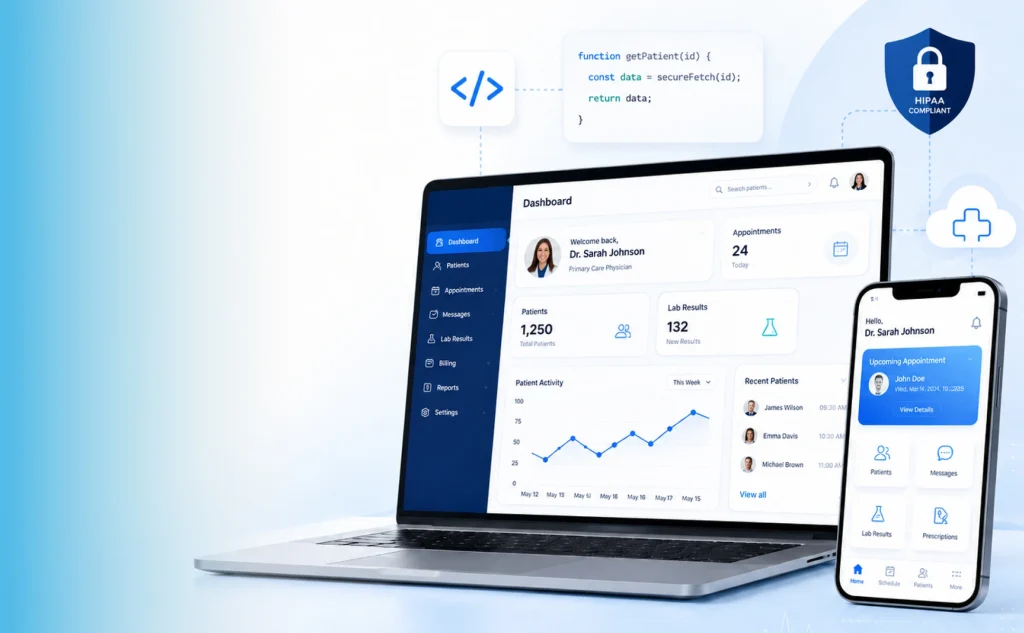
Healthcare software development focuses on designing, building, and maintaining digital solutions that support patient care, clinical workflows, and administrative operations. It spans everything from appointment systems and telemedicine to billing and data management. By leveraging technologies like AI, cloud computing, and analytics, these solutions improve efficiency, accuracy, and patient outcomes while reducing operational effort and costs.
At the same time, healthcare software plays a critical role in enabling better coordination across the entire care ecosystem. By connecting patients, providers, and healthcare organizations through unified platforms, it ensures seamless data flow, faster decision-making, and more personalized care delivery. This interconnected approach not only enhances clinical efficiency but also supports long-term healthcare innovation and scalability.
Key Takeaways
- Healthcare software plays a critical role across patients, medical professionals, and healthcare organizations, improving accessibility, decision-making, and operational efficiency.
- Core systems such as Hospital Management Software, EHRs, telemedicine platforms, and billing tools form the backbone of digital healthcare ecosystems.
- Modern solutions go beyond basic functionality by incorporating advanced technologies like AI, IoT, blockchain, and voice recognition to enhance care delivery and operational intelligence.
- Security is a fundamental requirement, with features like encryption, multi-factor authentication, audit logs, and secure integrations ensuring protection of sensitive patient data.
- A structured development process from discovery to maintenance is essential to ensure reliability, compliance, and real-world usability of healthcare software.
What is Healthcare Software Development?
Healthcare software development is the process of designing, building, and maintaining digital solutions that support the entire healthcare ecosystem from patient care and diagnosis to administrative workflows and financial operations. These solutions include tools that assist in disease diagnosis, automate appointment reminders, streamline medical billing and claims processing, manage patient data, and improve overall care coordination.
By integrating technologies like AI, cloud computing, and data analytics, healthcare software enhances accuracy, efficiency, and patient outcomes while reducing manual effort and operational costs.
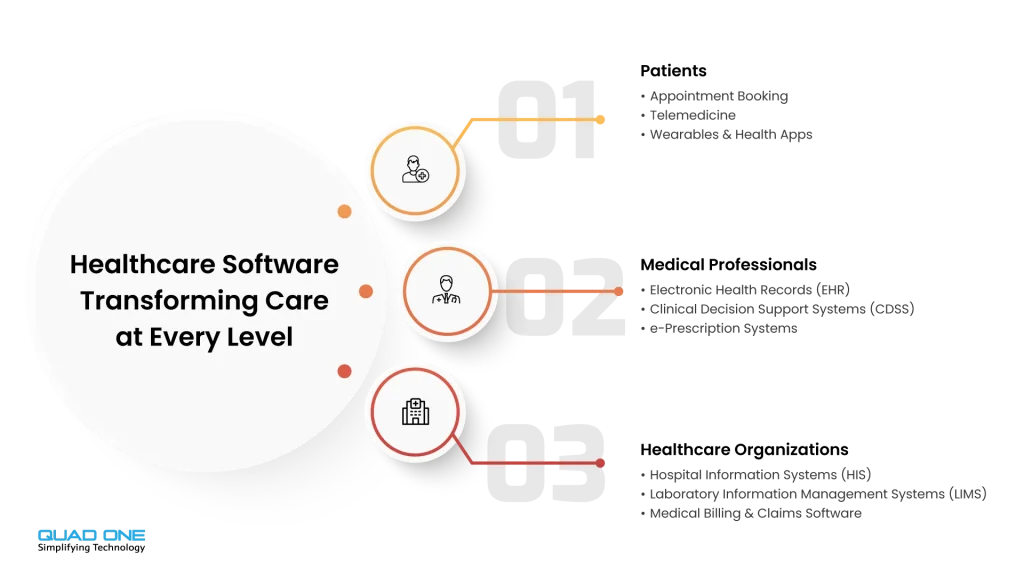
Who Benefits from Healthcare Software Development?
1. Patients:
Healthcare software empowers patients to take control of their health through accessible and user-friendly digital tools.
- Appointment Booking Systems: Patients can easily schedule, reschedule, or cancel appointments online without waiting in long queues.
- Telemedicine Platforms: Enable virtual consultations, reducing the need for in-person visits and improving access to care.
- Wearable Devices & Health Apps: Devices like smartwatches track vital signs such as heart rate, sleep patterns, and physical activity, helping in early detection and continuous monitoring.
2. Medical Professionals
Healthcare software significantly improves how doctors, nurses, and clinicians deliver care.
- Electronic Health Records (EHR): Centralized digital records of patient data, including medical history, diagnoses, medications, and lab results.
- Clinical Decision Support Systems (CDSS): Provide data-driven insights to assist in accurate diagnosis and treatment planning.
- e-Prescription Systems: Enable doctors to send prescriptions digitally to pharmacies, reducing errors and improving efficiency.
3. Healthcare Organizations
At an organizational level, healthcare software ensures smooth operations, compliance, and scalability.
- Hospital Information Systems (HIS): Integrate various hospital functions such as patient registration, billing, scheduling, inventory, and clinical management into a single platform.
- Laboratory Information Management Systems (LIMS): Manage lab workflows, sample tracking, test results, and reporting with high accuracy.
- Medical Billing & Claims Software: Automates insurance claims processing and coding.
Key Types of Healthcare Software
Key types of healthcare software are specialized digital tools that support everything from patient care and diagnostics to administration and billing. Each system plays a distinct role, working together to streamline operations, improve accuracy, and create a more connected and efficient healthcare experience
Hospital Management Software (HMS)
Hospital Management Software is a comprehensive digital solution designed to streamline the daily operations of healthcare facilities. It integrates multiple functions such as patient registration, appointment scheduling, admissions, discharge processes, billing, and inventory management into a single system.
By centralizing data across departments, HMS improves coordination between administrative and clinical teams. It also supports efficient resource utilization, including bed allocation and staff scheduling, ultimately enhancing patient experience while reducing manual workload and operational inefficiencies.
Electronic Health Records (EHR)
Electronic Health Records are digital versions of patients’ medical histories that are securely stored and easily accessible to authorized healthcare providers. These systems include detailed information such as diagnoses, medications, allergies, lab results, and treatment plans. EHRs eliminate the limitations of paper-based records by enabling real-time data sharing across different departments and even between healthcare organizations. This not only reduces errors but also supports informed clinical decisions, ensuring continuity of care and improved patient outcomes.
Telemedicine Software
Telemedicine software enables the delivery of healthcare services remotely through digital communication technologies such as video calls, mobile apps, and online platforms. It allows patients to consult doctors without physically visiting a clinic or hospital, making healthcare more accessible, especially in remote or underserved areas.
This software supports virtual consultations, follow-ups, chronic disease management, and even mental health services. By integrating with other systems like EHR and e-prescribing tools, telemedicine creates a seamless and connected care experience.
Health Tracking Apps
Health tracking apps are designed to help individuals monitor their daily health and wellness through smartphones and wearable devices. These applications track key metrics such as physical activity, heart rate, sleep patterns, and calorie intake, providing users with insights into their overall health. By encouraging consistent monitoring and offering reminders, these apps promote preventive care and healthier lifestyle choices. In some cases, the collected data can be shared with healthcare providers, enabling better long-term health management and early detection of potential issues.
E-Prescribing Software
E-prescribing software allows healthcare providers to create and send prescriptions electronically to pharmacies, eliminating the need for handwritten prescriptions. This significantly reduces errors related to illegible handwriting or incorrect dosages while improving patient safety through automated drug interaction checks. The system enhances efficiency by enabling faster processing and direct communication between doctors and pharmacists. Additionally, it maintains a digital record of prescriptions, making it easier to track patient medication history and ensure continuity of care.
Healthcare Billing Software
Healthcare billing software is essential for managing the financial operations of healthcare providers. It automates processes such as patient billing, payment tracking, insurance claims submission, and reimbursement management. By incorporating standardized medical coding systems, the software ensures accurate billing and compliance with regulations. It reduces administrative errors, speeds up claim processing, and improves revenue cycle management.
Additionally, it provides detailed financial reports and analytics, helping healthcare organizations make informed business decisions and maintain financial stability.
Need help planning a healthcare software project? QuadOne can help you define the right features, integrations, and development roadmap.
Contact QuadOne ➜
Advanced Healthcare Software Development Features
Modern healthcare software development goes beyond basic record keeping. Today’s healthcare platforms are expected to support automation, real-time access, better patient engagement, secure data exchange, and intelligent decision-making. These advanced features help hospitals, clinics, and healthcare businesses improve care delivery while reducing manual work.
AI and Machine Learning
AI and machine learning can help healthcare software identify patterns, support clinical decision-making, predict operational needs, and automate repetitive tasks. For example, AI can assist with patient risk prediction, appointment prioritization, medical coding, chatbot responses, and workflow automation.
IoT Integration
IoT integration allows healthcare platforms to connect with wearable devices, remote monitoring tools, and medical equipment. This helps providers collect real-time patient data such as heart rate, activity, glucose levels, or other health indicators, making continuous care and remote monitoring easier.
Voice Recognition
Voice recognition helps doctors and healthcare staff create notes, update records, and enter instructions using voice commands. This reduces manual documentation time and allows clinicians to focus more on patient interaction.
AI Chatbots
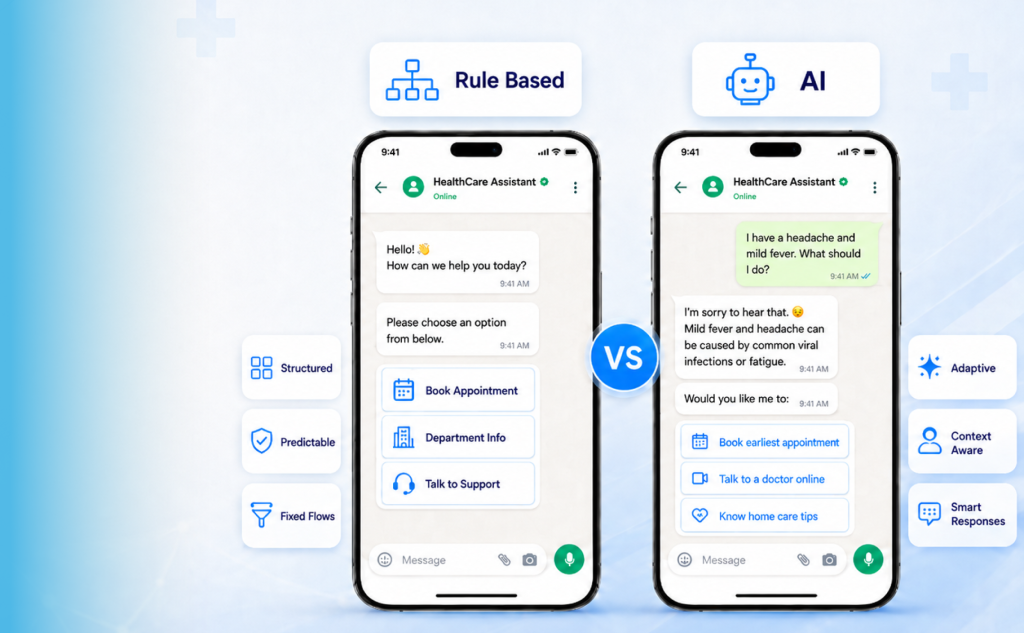
Conversational AI handles the high-volume, low-complexity interactions that otherwise consume front-desk and call-center capacity: appointment scheduling, prescription refill requests, symptom triage, and answering routine billing questions. A well-built healthcare chatbot escalates appropriately to a human when a conversation moves outside its competence, which is what separates a trustworthy deployment from a frustrating one.
Telemedicine Capabilities
Native telemedicine functionality, rather than a bolted-on third-party video plugin, allows consultations, e-prescriptions, and follow-up documentation to live inside the same record the rest of a patient’s care history occupies. This continuity matters most for chronic care management, where a remote visit needs to connect seamlessly to in-person treatment plans.
Mobile Accessibility
Clinicians increasingly expect the same platform they use on a hospital workstation to function just as well on a phone or tablet at the bedside or on a home visit. Mobile accessibility is no longer a nice-to-have layered on top of a desktop product; it is an expectation baked into any modern healthcare app development effort from day one.
Blockchain Technology
Blockchain can support secure record sharing, audit trails, insurance claim tracking, and drug supply chain verification. While not required for every healthcare platform, it can be useful in systems that need strong traceability and tamper-resistant records.
Security Features
Security is one of the most important parts of healthcare software development. Since healthcare platforms manage sensitive patient data, they must include strong protection features such as:
- End-to-end encryption
- Multi-factor authentication
- Data backup and disaster recovery
- Audit logs and compliance tracking
- Role-based access control
- Secure API integration
These features help protect patient information, control user access, support compliance, and reduce the risk of data breaches.
Healthcare Software Development Process
Healthcare software development is where technology meets life-critical care, turning complex medical workflows into smart, reliable digital systems. It goes beyond coding to ensure accuracy, security, and seamless integration with clinical environments, all while meeting strict regulations. The ultimate aim is to simplify healthcare delivery, reduce errors, and create a more connected, efficient, and patient-focused ecosystem.

Step 1: Discovery and Requirement Analysis
- Understand clinical workflows and user needs
- Identify regulatory and compliance requirements
- Gather stakeholder expectations (doctors, admin, patients)
- Define the exact problem the software will solve
- Prevent misalignment between technical teams and real-world use
Step 2: Planning and Strategy
- Define system architecture and technology stack
- Set project timeline and budget
- Identify integration needs (EHR, billing systems, etc.)
- Plan scalability and future enhancements
- Create a detailed development roadmap
Step 3: UI/UX Design
- Design simple, intuitive interfaces
- Focus on speed and ease of use
- Ensure usability under high-pressure clinical environments
- Reduce chances of user error
- Prioritize functionality over visual complexity
Step 4: Development
- Build the software in iterative sprints
- Continuously review progress with stakeholders
- Implement core features and integrations
- Embed compliance (e.g., HIPAA-aligned practices) into the system
- Ensure flexibility for future updates
Step 5: Quality Assurance and Testing
- Perform functional testing to identify bugs
- Conduct security and penetration testing
- Test system performance under heavy load
- Validate compliance with healthcare regulations
- Ensure reliability and data accuracy
Step 6: Deployment
- Roll out the software in phases
- Start with a limited department or facility
- Monitor performance in a controlled environment
- Fix issues before full-scale launch
- Minimize disruption to patient care
Step 7: Maintenance and Support
- Offer continuous technical support
- Provide ongoing updates and security patches
- Adapt to changing regulatory requirements
- Improve features based on user feedback
- Ensure system stability and performance
Healthcare Software Development Cost in 2026
Healthcare software development cost in 2026 depends on the type of solution, feature complexity, integrations, compliance needs, user roles, and long-term support requirements. A simple healthcare website, appointment booking system, or patient portal may require a smaller investment compared to a full hospital management system, telemedicine platform, AI-enabled healthcare CRM, or custom healthcare software solution.
For hospitals, clinics, diagnostic centers, and healthcare startups, cost should not be viewed only as a one-time development expense. The total cost also includes planning, UI/UX design, development, testing, security implementation, third-party integrations, deployment, maintenance, and future upgrades. Healthcare software usually requires more careful planning than regular business software because it handles sensitive patient data, clinical workflows, billing information, appointment records, and integrations with existing healthcare systems.
Key Factors That Affect Healthcare Software Development Cost
The final cost of healthcare software development depends on multiple factors:
- Type of healthcare software being developed
- Number of modules and user roles
- Custom UI/UX design requirements
- Web, mobile, or cross-platform development needs
- Integration with EHR, HIS, LIS, CRM, payment gateway, or telemedicine tools
- Data security and compliance requirements
- AI, automation, chatbot, analytics, or reporting features
- Cloud hosting, scalability, and performance requirements
- Testing, deployment, support, and maintenance needs
For example, a basic appointment booking platform will usually be simpler to develop than an AI-powered hospital CRM or an integrated hospital management system. Similarly, software that requires real-time communication, patient data exchange, medical device integration, or role-based dashboards will need more development effort.
Cost by Healthcare Software Type
| Healthcare Software Type | Complexity Level | Cost Impact |
|---|---|---|
| Healthcare website or patient information portal | Low to medium | Lower |
| Appointment booking system | Low to medium | Lower |
| Patient portal | Medium | Moderate |
| Telemedicine software | Medium to high | Moderate to high |
| Healthcare CRM | Medium to high | Moderate to high |
| Hospital management software | High | High |
| AI-powered healthcare software | High | High |
| Medical billing or claims software | Medium to high | Moderate to high |
| EHR/HIS-integrated platform | High | High |
The best way to control healthcare software development cost is to begin with a clear requirement document, define must-have features first, and build the platform in phases. This allows healthcare providers to launch faster, validate usage, and improve the software based on real operational needs.
Healthcare Software Compliance and Security Requirements
Healthcare software must be built with privacy, security, and compliance from the beginning. Unlike general software, healthcare applications manage sensitive patient information, appointment records, prescriptions, billing details, diagnostic reports, and communication between patients and providers. If security is treated as an afterthought, it can increase operational risk, reduce user trust, and create compliance challenges.
A strong healthcare software development approach should include secure architecture, controlled access, encrypted data handling, audit trails, secure APIs, and regular testing. These features help hospitals, clinics, and healthcare IT companies protect patient data while improving internal workflow efficiency.
Important Security Features in Healthcare Software
Healthcare software should include the following security and compliance-focused features:
- Role-based access control for doctors, admins, patients, and staff
- Data encryption during storage and transmission
- Multi-factor authentication for secure login
- Audit logs to track important system activity
- Secure API integrations with third-party systems
- Regular backup and disaster recovery planning
- User permission management
- Session timeout and access monitoring
- Secure cloud hosting and infrastructure protection
- Data validation and secure form handling
Compliance Considerations for Healthcare Software
Healthcare software compliance depends on the geography, users, and type of healthcare data being handled. For example, healthcare platforms serving the US market may need HIPAA-aligned data protection practices. Solutions used in Europe may need GDPR-focused privacy controls. Healthcare platforms in India may also need to consider local data privacy expectations and ABDM-related interoperability requirements where applicable.
Compliance should be planned during the requirements and architecture stage, not added after development is complete. This helps ensure that patient data, access control, consent, reporting, and integrations are designed properly from the start.
Why Compliance Matters
Compliance-ready healthcare software helps organizations:
- Protect sensitive patient data
- Improve trust among patients and providers
- Reduce operational and legal risks
- Support secure digital healthcare delivery
- Maintain better control over user access and data sharing
- Prepare for future scalability and integrations
For healthcare providers, security and compliance are not optional features. They are core requirements for building reliable, scalable, and trusted healthcare software.
Common Mistakes to Avoid in Healthcare Software Development
Treating healthcare software like general business software
Healthcare solutions require strict compliance, high data security, and alignment with clinical workflows. This makes them more complex than typical business applications.
Adding compliance too late
Regulatory and security requirements must be planned from the beginning. Retrofitting compliance after development can be risky, costly, and ineffective.
Prioritizing speed over validation
Faster development does not always lead to better outcomes. Speed without proper testing, validation, and security review can compromise patient safety, system reliability, and regulatory readiness.
Ignoring UI/UX design
In healthcare, intuitive design is critical. Doctors, nurses, admins, and patients need systems that are quick, clear, and easy to use under real-world pressure.
Assuming one solution fits every provider
Every hospital, clinic, and healthcare business has different workflows. Healthcare software should be tailored to the organization’s users, processes, integrations, and long-term goals.
How to Choose a Healthcare Software Development Company
Choosing the right healthcare software development company is one of the most important decisions for hospitals, clinics, healthcare startups, and medical service providers. The right development partner should not only understand technology but also understand healthcare workflows, patient experience, data security, integrations, and long-term scalability.
Healthcare software is different from regular business software because it often involves multiple users, sensitive data, compliance requirements, and integration with existing healthcare systems. A development company should be able to translate these requirements into a secure, easy-to-use, and scalable digital solution.
What to Look for in a Healthcare Software Development Partner
Before selecting a healthcare software development company, evaluate the following factors:
- Experience in healthcare software development
- Understanding of hospital, clinic, and patient workflows
- Ability to build custom healthcare software solutions
- Experience with healthcare CRM, telemedicine, patient portals, billing, or automation tools
- Knowledge of security, compliance, and data privacy requirements
- Strong UI/UX design capability for patients, doctors, and staff
- Integration experience with EHR, HIS, LIS, CRM, payment, or third-party systems
- Ability to build scalable web and mobile applications
- Post-launch support and maintenance capability
- Clear communication, documentation, and project management process
Questions to Ask Before Hiring a Healthcare Software Development Company
Healthcare providers should ask these questions before choosing a development partner:
- Have you built healthcare software or healthcare web applications before?
- Can you support custom healthcare software development based on our workflow?
- How do you handle patient data security?
- Can the software integrate with our existing systems?
- Do you provide post-launch support and maintenance?
- Can the platform scale as our hospital, clinic, or business grows?
- How do you approach UI/UX for doctors, staff, and patients?
- Can you help us build the software in phases?
A good healthcare software development company should act as a technology partner, not just a coding team. They should help healthcare organizations identify the right features, avoid unnecessary complexity, and build software that solves real operational problems.
Why Choose QuadOne for Healthcare Software Development?
QuadOne helps healthcare organizations build secure, scalable, and intelligent digital solutions that improve patient engagement, operational efficiency, and care delivery workflows. With experience across healthcare technology, AI-led automation, CRM, telemedicine, medical coding, machine integration, and custom application development, QuadOne supports hospitals, clinics, and healthcare businesses in building practical software solutions for real-world healthcare needs.
Unlike generic software development, healthcare software requires a strong understanding of workflows, user roles, data privacy, integrations, and patient experience. QuadOne focuses on building healthcare solutions that are not only technically strong but also usable for doctors, staff, administrators, and patients.
QuadOne’s Healthcare Software Capabilities
QuadOne supports healthcare organizations with:
- Custom healthcare software development
- Telemedicine software solutions
- AI medical coding solutions
- Content management systems for healthcare providers
- Custom application development
- Product development for healthcare businesses
Whether the requirement is a patient engagement platform, healthcare CRM, hospital website, telemedicine solution, AI automation tool, or custom healthcare application, QuadOne helps healthcare providers plan, build, and scale software that aligns with their operational goals.
Build Healthcare Software That Supports Growth
The right healthcare software can help organizations reduce manual work, improve patient communication, simplify operations, and create better digital experiences. QuadOne works with healthcare teams to understand their challenges, define the right technology roadmap, and develop solutions that support long-term growth.
If you are planning to build custom healthcare software for your hospital, clinic, or healthcare business, QuadOne can help you turn your idea into a secure, scalable, and user-friendly digital solution.
Conclusion
Healthcare software development is far more than just building an application. It involves creating secure, reliable, and intelligent systems that directly influence patient care and clinical outcomes. Success comes from combining the right technology, strict compliance, user-focused design, and continuous support.
When approached strategically, with ongoing updates and seamless integration, these solutions not only improve operational efficiency but also enhance patient experiences and empower better clinical decisions, making healthcare systems more connected and future-ready.
Build secure, scalable healthcare software with QuadOne. Contact our team to discuss your project.
Contact Our Team ➜