
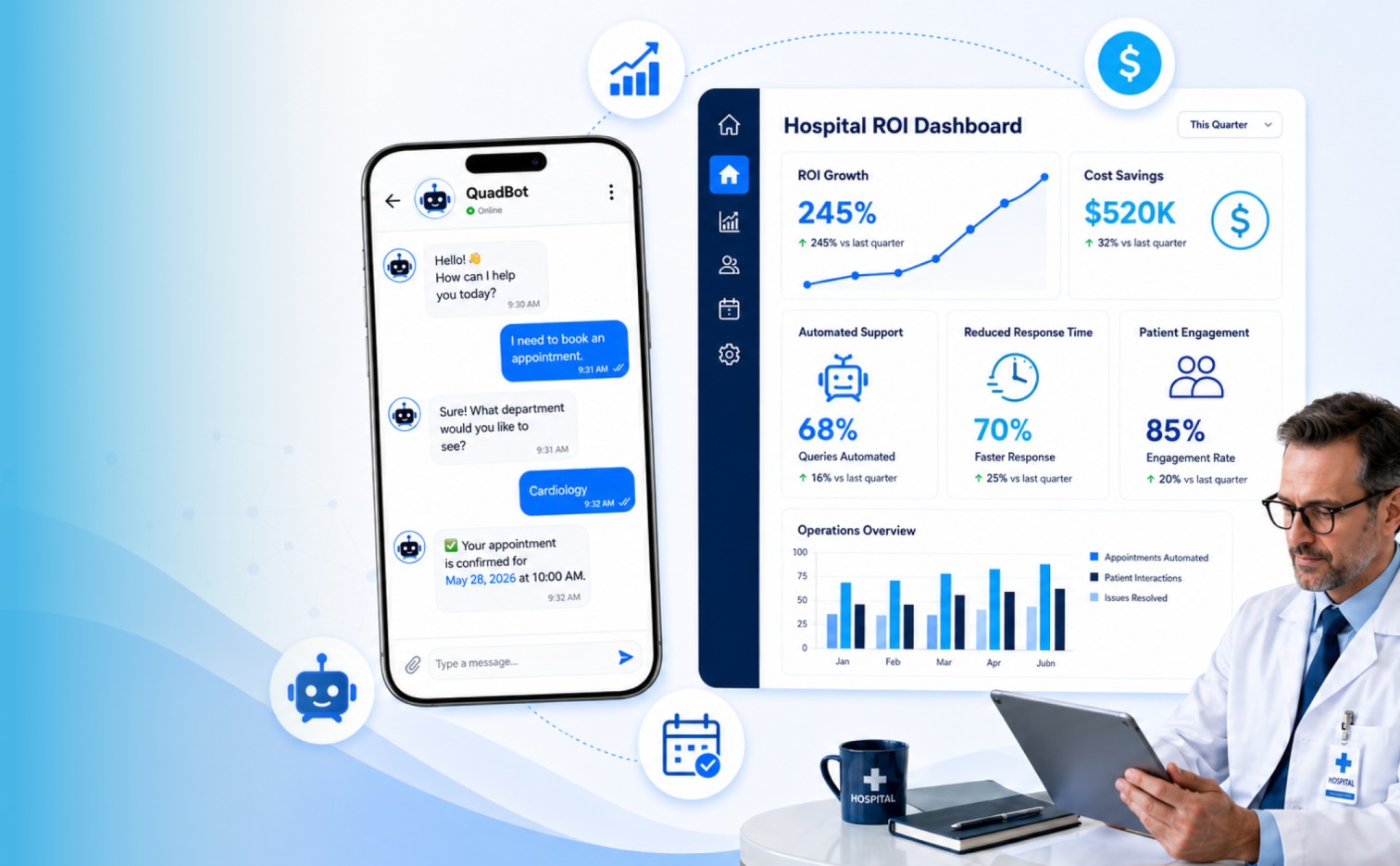
Chatbots are not thriving in the healthcare domain as it’s often assumed to be a simple, fully automated solution; instead, their value is shaped by compliance constraints, controlled automation, and the need for strong system integration. Measuring ROI goes beyond cost savings and requires evaluating operational efficiency, patient experience, and financial impact through metrics like staff time saved, query resolution rates, and no-show reduction.
Over the last year, chatbot adoption has accelerated rapidly, with usage increasing by approximately 25-30%, driven by demand for instant, automated customer and patient interactions. However, true ROI is realized when chatbots not only deflect queries but effectively resolve them, improve access to care, and enhance patient satisfaction, making them a strategic tool that balances efficiency with meaningful healthcare outcomes.
Key Takeaways:
- ROI in healthcare chatbots is multi-dimensional, combining financial, operational, and patient experience outcomes
- Compliance requirements (like HIPAA) limit full automation but ensure safe and measurable ROI
- The biggest immediate ROI comes from reducing administrative workload and saving staff time.
- Call deflection alone isn’t enough; true value comes from high query resolution without escalation.
- Tracking cost per resolved query + escalation rate gives a realistic picture of chatbot efficiency.
- Reducing no-shows and improving appointment conversions directly impacts hospital revenue.
- Faster response times lead to better patient satisfaction and engagement
- Chatbots improve follow-up adherence, especially in post-visit care and chronic condition management
- ROI becomes convincing when multiple metrics are combined into a clear business narrative
- Clinical ROI drives long-term value
How can hospitals measure the ROI of healthcare chatbots?
Healthcare Chatbots are an essential part of enhancing patient engagement and streamlining operations. Reducing administrative burden and measuring the return on investment (ROI) of these tools requires a structured approach that goes beyond simple cost savings. A meaningful ROI assessment should incorporate a balanced evaluation of financial impact, operational efficiency, and improvements in patient experience to truly capture their value within healthcare systems.
Why Healthcare Chatbot ROI Is Harder to Prove Than It Looks
Calculating ROI for a SaaS tool in most industries is straightforward: cost of the tool versus hours saved. Healthcare complicates this in ways that don’t show up in a typical way.
The Compliance Constraint on Automation
Every automated interaction touching patient data has to clear HIPAA before it can clear a spreadsheet. That means a chatbot’s ROI calculation isn’t just “queries handled minus queries escalated”; it has to account for what the chatbot is allowed to automate versus what still legally requires a human in the loop for consent, verification, or clinical judgment. This narrows the addressable volume, but it also means the ROI you do measure is on a smaller, more defensible base.
Where Adoption Actually Stands Today
Physician sentiment on AI tools has shifted markedly over the past two years, with adoption climbing across both administrative and clinical-adjacent use cases. The gap now isn’t whether providers will use AI-driven patient communication tools; it’s whether health systems can prove the tools are paying for themselves fast enough to justify scaling them, past pilot.
Smarter Conversations. Better Healthcare Outcomes.
Deploy AI chatbots that enhance patient experiences, reduce administrative burden, and help your organization operate more efficiently.
Get Started ➜The Financial Case: Cost Savings from Call Center Workload Reduction
Healthcare chatbots reduce call center workload by automating routine patient queries like appointment booking and follow-ups. This lowers call volumes, cuts staffing pressure, and delivers immediate, measurable cost savings.
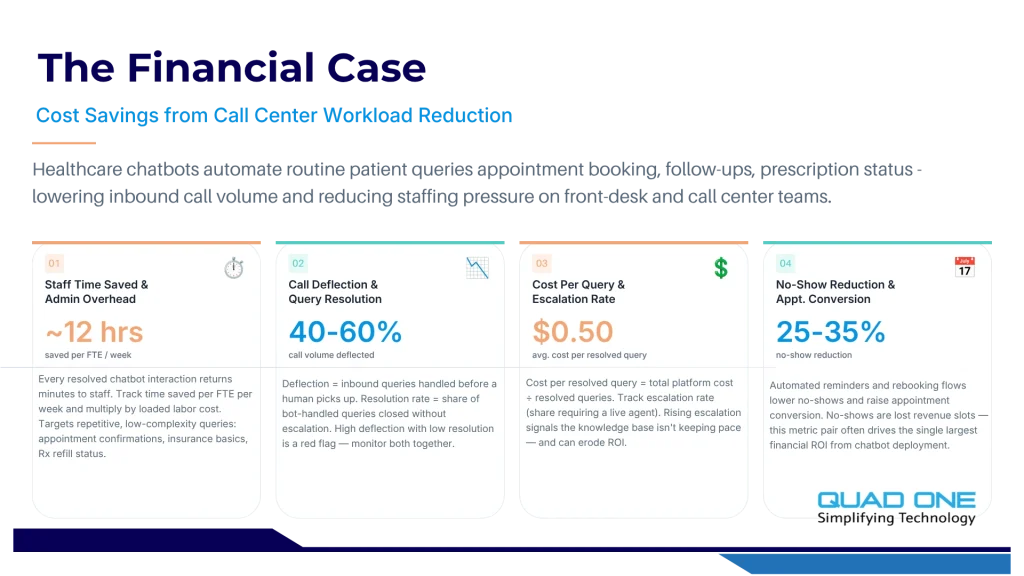
Metric 1 – Staff Time Saved & Administrative Overhead
Every call a chatbot resolves without human involvement is minutes returned to front-desk and call center staff. Track this as staff time saved per FTE per week, then multiply against loaded labor cost. Most health systems find the bulk of savings sits in repetitive, low-complexity queries: appointment confirmations, insurance basics, prescription refill status, rather than anything clinical.
Metric 2 – Call Center Workload Reduction & Query Resolution Rate
This is where call center workload reduction and patient query automation intersect. Two numbers matter here:
- Call volume deflected – the percentage of inbound queries the chatbot handles before a human ever picks up
- Query resolution rate – of the queries the bot attempts, how many it actually closes without needing escalation
A high deflection rate paired with a low resolution rate is a red flag; it usually means the bot is absorbing calls, not resolving them, which just delays the workload rather than reducing it.
Metric 3 – Cost Per Resolved Query & Escalation Rate
Cost per resolved query is the number that lets you compare a chatbot against a human agent on equal footing. Divide total platform cost by resolved (not attempted) queries, and track it alongside escalation rate, the share of conversations that still require a live agent. A rising escalation rate over time can signal the bot’s knowledge base isn’t keeping pace with new query types, which erodes ROI even if raw volume looks good.
Metric 4 – No-Show Reduction & Appointment Conversion
Automated, well-timed reminders and rebooking flows do two things at once: they lower no-show rates and lift appointment conversion, the percentage of chatbot-initiated scheduling conversations that end in a confirmed booking. Because a no-show is a fully lost revenue slot, this metric pair often produces the single largest line item in the financial ROI case, larger even than labor savings.
Build Your Business Case: Free ROI Calculator
Rather than estimating these metrics in the abstract, plug your own call volume, staffing costs, and no-show rate into our free calculator to see a projected 12-month return before you commit to a vendor conversation.
Healthcare Chatbot Performance Metrics That Prove the ROI
Beyond the headline financial numbers, a handful of operational metrics tell you whether the deployment is actually healthy day to day.
Patient Response Time
The average time between a patient’s message and a resolution (bot or human) is one of the clearest healthcare chatbot performance metrics to track, because it correlates directly with satisfaction scores. Sub-minute response times on routine queries are now a realistic bar for AI-driven systems, versus the multi-hour lag common with call-back queues.
Follow-Up Completion Rate
For chatbots handling post-visit check-ins or care plan reminders, follow-up completion rate the share of scheduled follow-ups a patient actually completes after a chatbot nudge is an early proxy for clinical impact before longer-term outcome data is available.
From Individual Metrics to Measurable Business Impact
These numbers don’t mean much on their own. What really matters is putting them together into one clear outcome: how much staff time was saved, how much revenue was recovered, and what it cost per query. That’s the kind of simple, measurable impact that decision-makers actually care about.
The Clinical ROI: What AI Chatbot ROI Means for Patient Care
Financial metrics get the deployment approved. Clinical metrics get it renewed.
Medication Adherence Gains
Automated refill reminders and dosage check-ins measurably reduce missed doses, particularly for chronic condition management where adherence gaps are the leading driver of preventable readmissions.
Patient Satisfaction
Faster response times and 24/7 availability tend to lift CSAT and NPS scores, though these should be tracked as a secondary metric alongside resolution rate; a fast reply to an unresolved question doesn’t move the needle the way a fast resolution does.
Widening Access to Care
Multilingual and asynchronous chatbot access lowers the practical barrier to reaching a health system outside business hours or across a language gap a benefit that’s real but harder to monetize directly, which is why it belongs in the clinical rather than financial section of the business case.
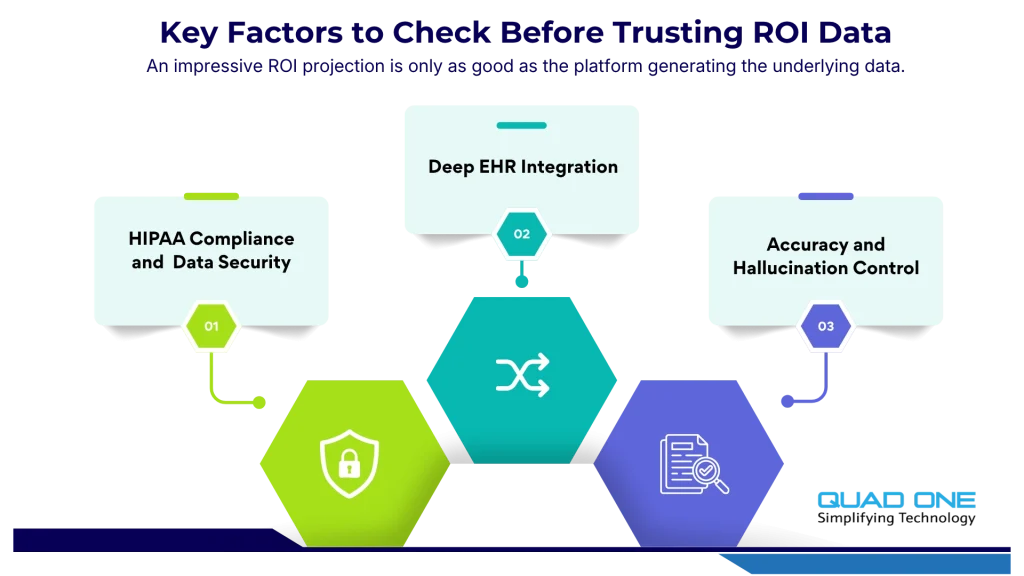
Key Factors to Check Before Trusting ROI Data
An impressive ROI projection is only as good as the platform generating the underlying data.
HIPAA Compliance and Data Security
Confirm BAAs are in place and that the vendor’s data handling, storage, encryption, and retention are auditable, not just marketed as “HIPAA-compliant” in a sales deck.
Deep EHR Integration
A chatbot that can’t read or write to the EHR in real time will always have an artificially low resolution rate, because it can’t actually complete the transaction the patient is asking about.
Accuracy and Hallucination Control
In a clinical-adjacent context, an incorrect but confident chatbot answer isn’t a minor bug; it’s a liability. Any ROI model should discount for the cost of hallucinated responses that damage trust or trigger compliance review, not just count resolved queries at face value.
Seamless Integration. Reliable Results.
Quad One helps you achieve ROI that’s not just promised, but proven across compliance, integration, and accuracy.
Contact Us ➜Turning These Numbers Into Your Own Chatbot ROI Case
The health systems getting the most out of chatbot deployments aren’t the ones with the flashiest bot; they’re the ones tracking the right eight or nine numbers consistently, month over month, and tying them back to dollars and patient outcomes. Start with staff time saved and no-show reduction, since those are usually the fastest to quantify, then build out toward the fuller picture above.
Conclusion:
At its core, measuring the ROI of healthcare chatbots isn’t just about numbers; it’s about understanding the real impact on people and processes. Every minute saved for a hospital staff member is time that can be redirected toward patient care. Every reduced no-show represents a patient who didn’t miss critical treatment. Every instant response is a moment where a patient feels heard, supported, and guided.
The true value of chatbot ROI lies in this intersection of efficiency and empathy. When hospitals move beyond viewing chatbots as cost-saving tools and start seeing them as enablers of better care delivery, ROI becomes more than a metric; it becomes a reflection of improved healthcare experiences.