
Today, handling a patient’s medical record is a serious responsibility, as it contains highly sensitive personal and medical information. Protecting this data is essential to maintain patient trust and privacy.
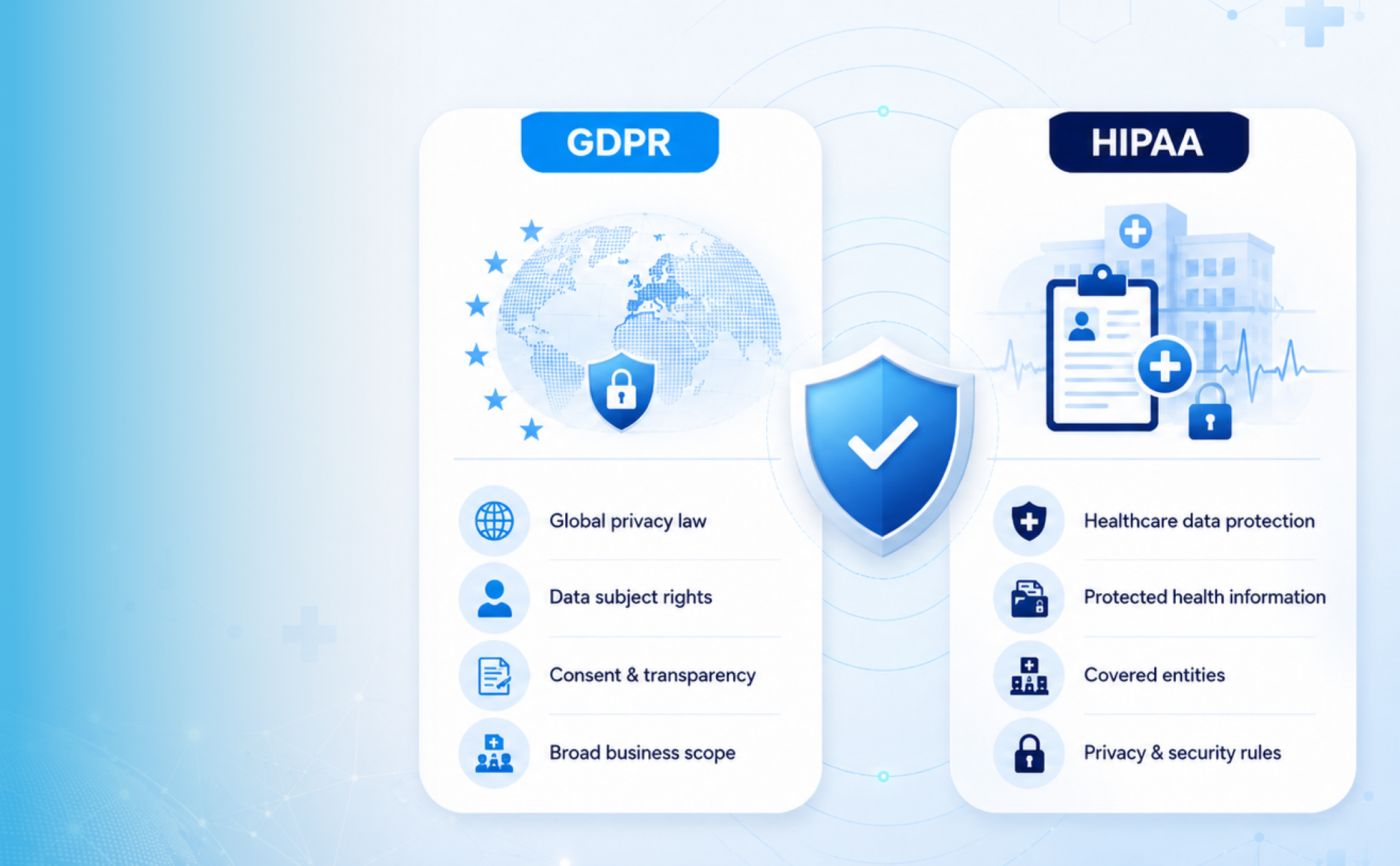
To ensure this, two key regulations are in place: HIPAA and GDPR. HIPAA focuses on safeguarding patient health information in the United States, ensuring confidentiality and secure data handling. GDPR, applicable in the European Union, emphasizes data privacy, consent, and gives individuals greater control over their personal information. Together, these frameworks highlight the importance of securely managing patient data and upholding ethical standards in healthcare.
Key Takeaways
- Handling patient medical records comes with a high responsibility due to the sensitive nature of the data involved.
- HIPAA and GDPR are the two major frameworks ensuring data privacy and security in healthcare.
- GDPR applies globally to any organization handling EU residents’ data, while HIPAA is limited to U.S. healthcare entities.
- GDPR covers all personal data across industries, whereas HIPAA focuses only on Protected Health Information (PHI).
- GDPR gives individuals broader rights, including data deletion and portability, while HIPAA mainly allows access and correction.
- Breach reporting timelines differ significantly: GDPR requires reporting within 72 hours, while HIPAA allows up to 60 days.
- Many healthcare organizations must comply with both regulations due to global patient reach.
- Vendor accountability is critical; both regulations hold organizations and their partners responsible for data breaches.
What is GDPR?
The General Data Protection Regulation (GDPR) is the European Union’s framework for how organizations collect, store, and use personal data. It came into force in 2018, and honestly, it changed the way most of the world thinks about privacy, not just companies operating in Europe. If a healthcare platform, app, or CRM touches the data of anyone in the EU, GDPR applies, regardless of where the company itself is based.
It gives individuals real control: the right to know what’s being collected, the right to ask for it to be deleted, and the right to move their data elsewhere if they choose. For healthcare providers, that control extends to some of the most sensitive information there is, like diagnoses, treatment history, and genetic data, which GDPR classifies as “special category” data requiring extra safeguards.
What is HIPAA?
The Health Insurance Portability and Accountability Act (HIPAA) is the U.S. law governing how healthcare providers, insurers, and their business associates handle patient health information. Passed in 1996, it set the baseline for what’s now called Protected Health Information (PHI), covering everything from medical records to billing details to conversations between a doctor and patient. HIPAA’s Privacy Rule and Security Rule work together: one governs who can access PHI and under what circumstances, the other mandates the technical and administrative safeguards needed to keep that data secure. Unlike GDPR, HIPAA is sector-specific. It applies only to healthcare entities and their vendors, not to every industry handling personal data.
Key Differences Between GDPR and HIPAA
GDPR and HIPAA are both designed to protect sensitive data, but they differ in scope and application. GDPR covers all personal data across industries within the EU, while HIPAA is specific to safeguarding healthcare information in the U.S., making GDPR broader and HIPAA more specialized.
| Aspect | GDPR | HIPAA |
| Jurisdiction | European Union (applies globally to anyone handling EU residents’ data) | United States only |
| Enacted | 2018 | 1996 |
| Scope | All personal data, across every industry | Protected Health Information (PHI) in healthcare only |
| Who Must Comply | Any organization processing EU residents’ data, regardless of location | U.S. healthcare providers, insurers, and their business associates |
| Data Covered | All personal data; health data falls under “special category” with extra protection | Specifically PHI — medical records, billing info, patient communications |
| Individual Rights | Right to access, erasure (“right to be forgotten”), portability, and correction | Right to access and request corrections to health records (no explicit erasure right) |
| Consent Requirements | Explicit, opt-in consent required for data processing | Consent required for use/disclosure of PHI, with treatment-related exceptions |
| Breach Notification | Within 72 hours of discovery | “Without unreasonable delay,” within 60 days |
| Core Focus | Individual control over personal data | Secure handling and limited access to health data |
| Penalty | Up to 4% of global annual revenue or €20 million, whichever is higher | Tiered fines based on negligence level, up to $1.5M per violation category/year |
Does HIPAA or GDPR Apply to Your Organization?
This is usually the first question that trips people up, and it’s a fair one. The honest answer is: it depends on whose data you’re touching and where they live, not where your company happens to be headquartered. A lot of digital health platforms end up needing to satisfy both HIPAA and GDPR compliance requirements at once, simply because their patients aren’t confined to one country anymore.
Who Does HIPAA Apply To?
HIPAA applies to healthcare organizations in the United States, such as hospitals, clinics, health insurers, and clearinghouses. It also extends to third-party vendors, known as “business associates,” like CRM providers, EHR systems, or AI tools that handle patient data for these organizations. This means even if a company is not directly involved in patient care, it must still follow HIPAA rules if it accesses or processes protected health information on behalf of a covered entity.
Who Does GDPR Apply To?
GDPR doesn’t really care where your servers are or where your company is registered. What matters is whose personal data you’re processing. If a single patient based in the EU uses your platform, books an appointment, or fills out a health form, GDPR kicks in for that interaction, regardless of whether your organization is based in Hyderabad, Chicago, or anywhere else. This is exactly why so many healthcare technology companies end up designing for GDPR compliance requirements from day one, even if their primary market is elsewhere; it’s simpler to build once for the stricter standard than to retrofit later.
Key Similarities Between GDPR and HIPAA
- Both focus on protecting sensitive health-related data and ensuring patient privacy.
- Both require organizations to implement strong security measures to safeguard data from breaches and misuse.
- Both give individuals rights over their data, such as access and correction.
- Both enforce accountability, meaning organizations are responsible for how data is handled even when third-party vendors are involved.
- Both mandate breach notifications, requiring organizations to inform affected parties within a defined timeframe.
- Both emphasize the importance of data governance and compliance programs to ensure ongoing protection and monitoring.
GDPR vs HIPAA: A Comparison of Protected Data
Both laws protect health data, but they define it differently, and that difference matters more than people expect. HIPAA is narrowly focused on protected health information, commonly shortened to PHI. That’s medical records, treatment notes, billing details, insurance information, and basically anything that connects a person’s identity to their health status or care.
Personal data under GDPR is a much wider net. It covers anything that can identify a person: names, email addresses, IP addresses, location data, not just health-related information. Health data sits inside that net as a “special category,” which means it gets an extra layer of protection on top of GDPR’s already broad baseline.
Data Breach Notification Deadlines Under GDPR and HIPAA
One key difference between GDPR and HIPAA is the time frame for reporting breaches. GDPR requires notification within 72 hours, while HIPAA allows up to 60 days, highlighting how GDPR pushes for immediate transparency, whereas HIPAA allows more time for investigation.
HIPAA Breach Notification (HITECH Act)
Under the HITECH Act, covered entities and their business associates must notify affected individuals without unreasonable delay, and no later than 60 days after discovering a breach. If the breach affects 500 or more individuals, HIPAA also requires notifying the U.S. Department of Health and Human Services and, in many cases, the media. It’s a longer runway than GDPR gives you, but the paperwork trail HIPAA expects is detailed and specific.
GDPR Breach Notification (Articles 33 and 34)
GDPR moves faster. Articles 33 and 34 require organizations to notify their relevant supervisory authority within 72 hours of becoming aware of a breach, and to notify affected individuals directly if the breach poses a high risk to their rights and freedoms. Seventy-two hours is not a lot of time once you factor in investigation, containment, and internal sign-off, which is why breach response planning has become a core part of digital health compliance rather than an afterthought.
What Rights Do Patients Have Under HIPAA vs. GDPR?
Patients generally have more direct control over their data under GDPR than under HIPAA, and that’s worth being upfront about. Under HIPAA, patients can access their records, request corrections, and ask for an accounting of who their data was shared with. What HIPAA doesn’t give them is an explicit right to deletion; health records are often retained for legal and clinical reasons regardless of a patient’s preference.
GDPR goes further. Patients get the right to access, correct, restrict processing of, and in many cases erase their data the well-known “right to be forgotten.” They can also request their data in a portable format to move to another provider. For any organization building patient-facing tools, this difference shapes real product decisions: a “delete my account” button that works fine for a GDPR-only audience may need a very different backend for HIPAA-covered records.
Vendor Breaches: Who Holds the Responsibility?
This is where a lot of healthcare technology companies get caught off guard. Under both frameworks, using a third-party vendor doesn’t transfer away your responsibility; it just adds another party who shares it.
HIPAA requires a signed Business Associate Agreement (BAA) with any vendor touching PHI, and if that vendor causes a breach, both the covered entity and the vendor can be held liable depending on where the failure occurred. GDPR works similarly through Data Processing Agreements between “controllers” and “processors,” and regulators have shown they’re willing to fine either party, not just whoever collected the data first.
The practical takeaway: vetting a vendor’s security posture isn’t a box-ticking exercise; it’s genuinely part of your own patient data protection strategy. If your Quad Bot, Quad Engage CRM, or HIS integration touches a third-party analytics tool or cloud provider, that relationship needs a paper trail before anything goes live, not after something goes wrong.
Building a Compliance Program for Both GDPR and HIPAA
Honestly, the good news here is that you don’t need two separate compliance programs running in parallel. Most organizations find it easier to build one program to the higher standard and let it cover both. Here’s roughly how that comes together in practice:
● Map your data first. You can’t protect what you haven’t identified or know exactly where PHI and personal data live, move, and get stored across every system.
● Build consent and access controls to GDPR’s stricter bar. Explicit, opt-in consent and role-based access tend to satisfy HIPAA’s requirements automatically.
● Standardize breach response around the tighter deadline. Designing your incident response for GDPR’s 72-hour window means you’ll never miss HIPAA’s 60-day one.
● Formalize every vendor relationship. BAAs for U.S. vendors, DPAs for anything touching EU data no exceptions, no verbal agreements.
● Train your team regularly. Most breaches trace back to human error, not sophisticated attacks, so ongoing staff training is one of the highest-return investments you can make.
● Audit on a schedule, not just after an incident. Regular internal reviews catch small gaps before they become regulatory findings.
Conclusion
HIPAA and GDPR both play a crucial role in protecting patient data, but they differ in scope, applicability, and strictness. While HIPAA focuses on safeguarding healthcare data within the United States, GDPR applies more broadly across the European Union, covering all personal data with stricter privacy controls.
As healthcare becomes increasingly digital and global, organizations often need to comply with both frameworks rather than rely on just one. Adopting a unified, high-standard approach to data protection not only ensures compliance but also builds trust, supports ethical care, and safeguards one of the most sensitive assets in healthcare: patient information.
External References
What Are the Key Differences Between GDPR and HIPAA?